Launch of the African Hub on AI Safety, Peace and Security
Nasief Manie
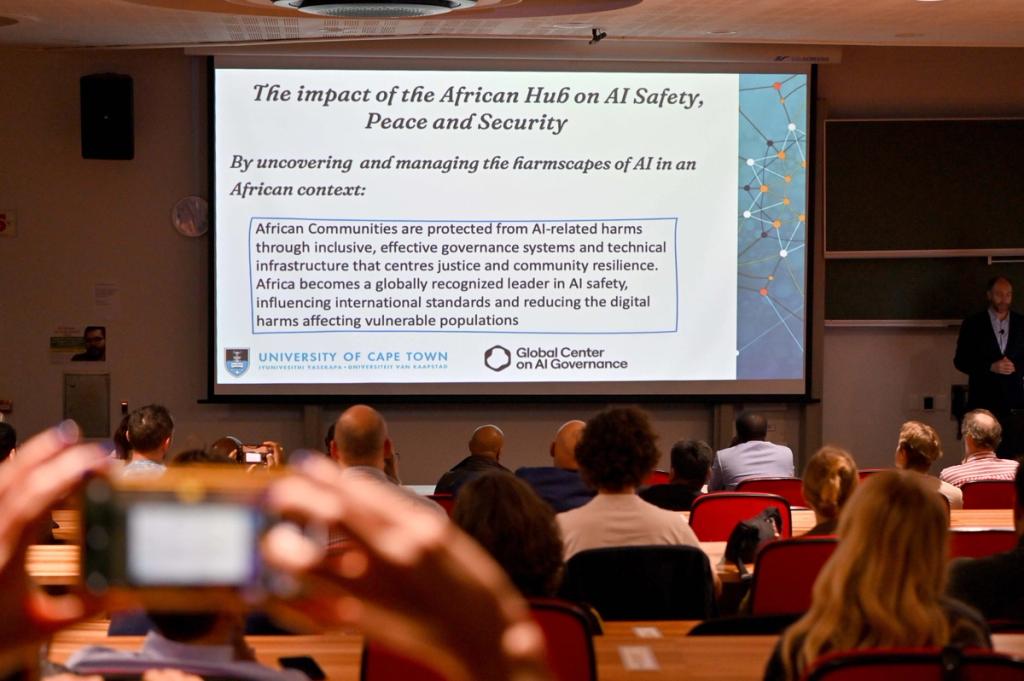
The Global Center on AI Governance and the University of Cape Town (UCT) have proudly partnered to launch the African Hub on AI Safety, Peace and Security. This initiative marked a significant moment for Africa to contribute and lead global debates on ethical and inclusive technology. The hub is a multidisciplinary AI lab established under the AI4D network, supported by the International Development Research Centre (IDRC) of Canada and the UK's Foreign, Commonwealth and Development Office (FCDO).
Its mission is to ensure African perspectives, voices, knowledge, and priorities are central to global AI safety discussions. Operating from UCT, the Hub serves as an avenue for advancing multidisciplinary research and collaboration to find tangible ways to mitigate the harms associated with increasingly powerful and pervasive AI systems across the continent.
To achieve this, the Hub will focus on two distinct, yet related, concepts:
- AI Safety: Emphasizing the technical solutions needed to ensure AI systems operate reliably and safely, avoiding new harms or exacerbating existing risks.
- AI Security: Concentrating on defending AI systems against intentional, malicious threats ("defense by default").
By focusing on these areas, the Hub aims to prevent harm to both individual and group consumers while affirming Africa's role as a leader in contextual, human-rights, and multi-cultural AI governance and regulation.
Consolidating Leadership and Influence through Partnership
Africa seeks to both absorb knowledge and exert influence, ensuring that locally developed solutions address homegrown problems while offering novel ways of tackling important global challenges. Prof. Mosa Mashabela, Vice-Chancellor of UCT, echoed this sentiment, stating:
“It's important to note that our homegrown solutions may be tailored to homegrown problems that we encounter every day, but also that this technological innovations can be shared with the rest of the continent and the rest of the world as novel ways of tackling important global challenges. We are not only launching a hub, we are affirming our role in leading Africa’s contribution to the future of AI safety.”
This drive for leadership is strengthened by strategic regional and global partnerships, such as those within the AI4D community. Emily Middleton, Director General, UK Department for Science, Innovation and Technology, shared:
“I hope this new African Hub for AI Safety, Peace and Security can be a much-needed centre of gravity for African-led research on these topics, which will enable the bold vision in the AI for Africa initiative to become a reality and yield groundbreaking insights that all of us across the G20 and the wider world can learn from and use.”
The need for a proactive, Africa-led approach is paramount. As Dr. Chinasa T. Okolo argued, the Hub offers a necessary reconciliation:
“This is precisely why the hub represents such a transformative opportunity. Rather than waiting for external actors to eventually consider our needs, this initiative positions Africa as a proactive leader in defining what AI safety means in our context. This hub represents a commitment to ensuring that the next generation of Africans guide an AI-enabled world that amplifies, rather than diminishes, their heritage, their potential, and also their agency.”
Informing Continental Policy
The Hub's work is directly tied to the principles guiding the continent's AI future. The fourth guiding principle of the African Union’s Continental AI strategy, Peace and Prosperity, mandates that "The production, development, use and assessment of AI systems in Africa shall advance peaceful and prosperous African societies, where safety and security are enjoyed by all who live in them and where the natural environment is preserved and protected." Dr. Rachel Adams, CEO of the Global Center on AI Governance and a lead drafter of the strategy, emphasized the need to operationalize these principles through a locally relevant approach. In speaking about the hub's aim to respond to the continent's needs and inform these policy agendas, Dr. Adams highlighted the foundational work required: “Through understanding the kinds of epistemologies and methodologies we need to understand these risks, and from there how do we begin to address them, and how do we address them in ways that work with the resources that we have.”
The African Hub for AI Safety, Peace and Security represents a vision for a future where Africa defines, not merely adopts, the standards of responsible AI. By transforming its diversity into a driver of resilience, and its challenges into blueprints for equitable technology, Africa can shape the moral and technical frontiers of global AI governance.
Learn more about the African Hub on AI Safety, Peace and Security: https://www.ai4d.ai/projects/african-hub-on-ai-safety-peace-and-security