WEBINAR: How AI Can Accelerate Africa’s Scientific Breakthroughs Event
Part of The Big AI Debate: Africa’s Outlook Series
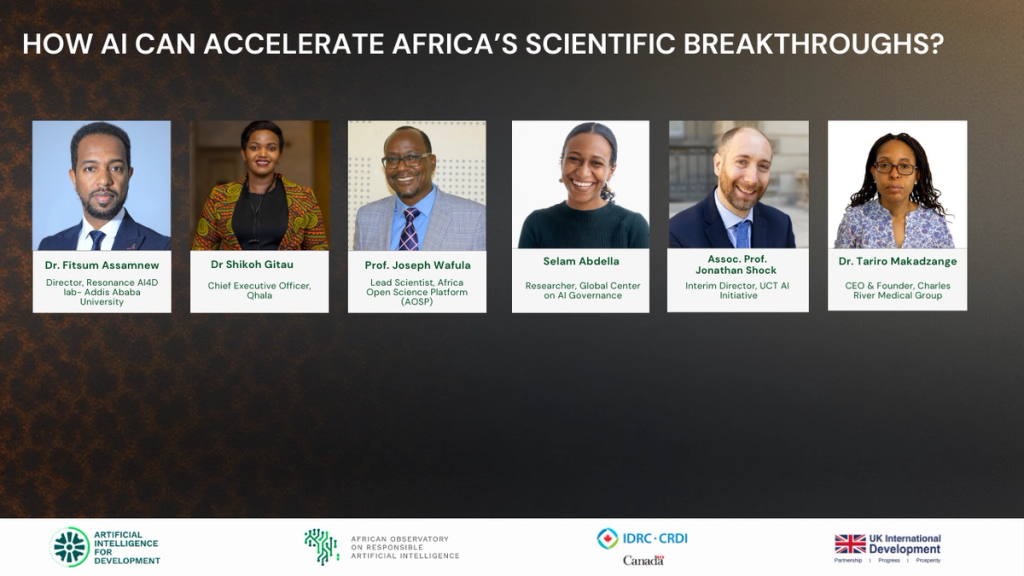
This second webinar in The Big AI Debate: Africa’s Outlook, hosted by the African Observatory on Responsible AI and the Artificial Intelligence for Development (AI4D) program explored how Artificial Intelligence can accelerate scientific progress across Africa. Moderated by Selam Abdella, the session brought together leading experts including Assoc. Prof. Jonathan Shock, Dr. Shikoh Gitau, Dr. Fitsum Assamnew Andargie, and Dr. Tariro Makatange to explore the continent’s unique scientific challenges and the role of AI in addressing them.
AI in Drug Discovery
Assoc. Prof. Jonathan Shock shared insights into AI-driven drug discovery efforts at the University of Cape Town, including work by the H3D Centre, led by Kelly Chibale, on malaria, tuberculosis, and antimicrobial resistance. He emphasized that real breakthroughs require strong collaboration between AI scientists, bench scientists, and local communities. With more AI-generated candidates now reaching clinical trials globally, Jonathan noted that the future of AI-enabled therapeutics looks increasingly promising.
Collaborative Research Models
Dr. Fitsum Assamnew Andargie described the Resonance Lab’s multidisciplinary approach, integrating AI researchers with domain experts in agriculture, health, energy, and governance. He stressed that meaningful AI innovation depends on deeply understanding real-world challenges. Fitsum also reflected on the lab’s investments in computational infrastructure, including GPU-powered machines to support advanced research.
AI and the Future of Clinical Trials in Africa
Tariro Makatange emphasized the need for Africa to significantly expand its participation in global clinical trials. She argued that AI and large-scale datasets could accelerate trial processes and unlock more inclusive research.
Dr. Shikoh Gitau showcased Qhala’s “Africa AI Enablement Flywheel” and their work on health-focused AI models, including breast-cancer detection tools. Her insights highlighted the importance of data sharing, strong governance frameworks, and building talent pipelines that can sustain Africa’s AI ambitions.
A Call for Pan-African Collaboration
Across the conversation, experts agreed that Africa’s scientific future will depend on coordinated, pan-African efforts to share data, strengthen infrastructure, and build trust in AI systems. The webinar concluded with a call for deeper collaboration and an invitation to upcoming sessions exploring agentic AI.