Scaling What Works: The RICH's Search for Africa's Viable Climate-AI Solutions

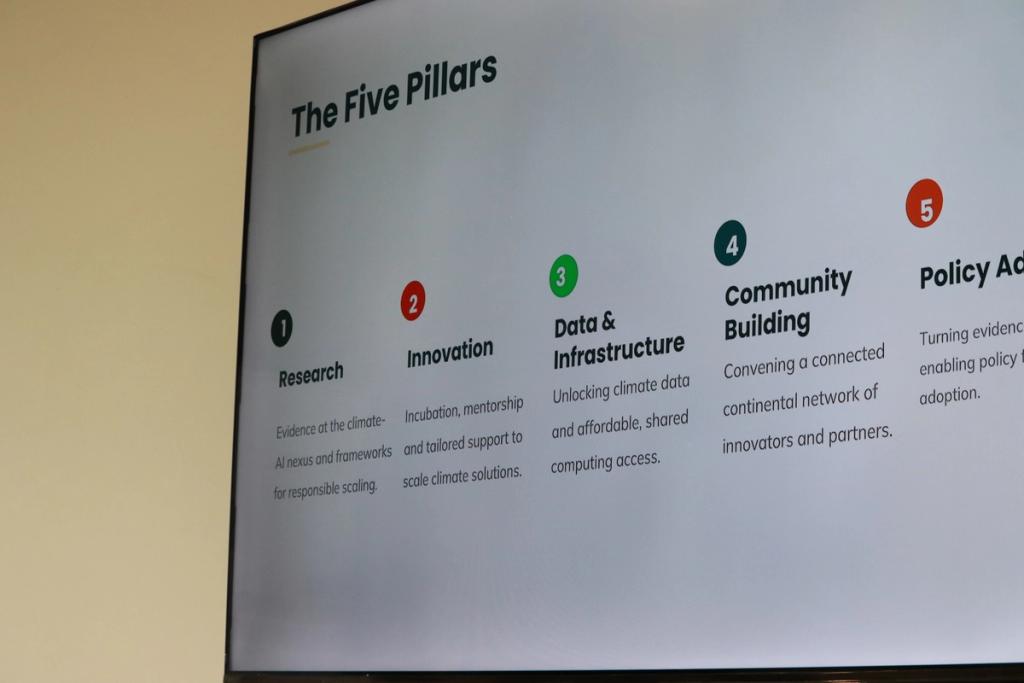
Inside the Launch of the Research & Innovation for Climate Hub (RICH) At The Global Data Festival In Nairobi, Kenya in June 2026
"Once you've unlocked environmental data, then what?"
It might be a simple question, but it lingered in the room during the launch of the Research & Innovation for Climate Hub (RICH), at the Global Data Festival in Nairobi.
Africa has no shortage of environmental data. Satellites capture weather patterns, sensors generate environmental information, and researchers produce new insights every day. Yet one challenge remains: how do we turn that information into decisions that improve people's lives? How do we bridge the gap between a rainfall estimate sitting in a server somewhere and a farmer who wants to know whether to plant this week or not. These are some of the questions the Research & Innovation hub is working through to make sure that climate innovations reach the communities that need it the most.
The term “Launch” might be misleading since there was no flagship product, no finished platform, nor a five-year track record to point to. What we had rather was a clear sense of who the hub serves, and an intentional definition of how change can actually be realised. Together with its partners, RICH is building an ecosystem that connects research, AI innovation, data infrastructure, community building, and policy engagement to promote climate resilience in Africa. Its goal is to move promising climate AI innovations beyond pilots and into scale-readiness.
Leonida Mutuku, Director of RICH emphasised during this event that the stakes are far from abstract. For instance, for millions of smallholder farmers across Africa, a delayed rainfall season or a forecast that is wrong by just a few days can adversely impact the means to livelihoods. The Hub aims to ensure that artificial intelligence is applied responsibly to local realities, in order to help address these challenges. Beyond climate-smart agriculture, AI is used for cases like forecasting extreme weather and floods, optimizing power grids to integrate renewables and cut energy waste, improving climate models and carbon-sink monitoring, tracking deforestation and illegal logging via satellite imagery, and detecting methane leaks from industrial sites.
The Hub screens AI use cases on two axes:
- Feasibility :can it actually be built and deployed within our African contexts, given available funding, data, infrastructure, technical skills, and energy and connectivity constraints? and;
- Viability :does it make sense to sustain, meaning is there a sustainability model, institutional ownership, policy and regulatory fit, and measurable climate or development return that outlasts the pilot?.
Many promising AI-and-climate ideas pass one test but fail the other: flood forecasting for instance, may be highly viable in its impact yet infeasible where ground-station data is sparse, or, while a slick carbon-monitoring tool may be technically feasible but commercially unviable with no one willing to pay to run it.
The Hub looks specifically for use cases that clear both bars with the intention of understanding the early signals of an AI’s likelihood of scaled impact and improved community resilience to climate change. . Scaling multiplies cost and risk, so a use case must be feasible enough to replicate across different contexts without rebuilding from scratch, and viable enough that local institutions, governments, or markets will keep it alive after the hub's support ends. In short, the Hub is not collecting interesting AI experiments; it is hunting for the narrow set of solutions where the technology works on the ground, the economics hold up, and the climate impact is large and repeatable enough to justify taking from a single pilot to regional deployment. That filter is what turns a portfolio of demos into infrastructure that can move the needle on climate resilience and mitigation.
This commitment to responsible innovation shapes the Hub's approach. The Hub favours public-interest pathways such as national meteorological agencies, government institutions, and public service systems. We describe our role as providing “kindling, not just capital” i.e. catalytic resources in the form of scaling grants, tailored coaching, demonstration opportunities, access to policy spaces, and strategic support for innovations that have already shown potential. By working with small cohorts, the Hub aims to learn alongside innovators, refine our approach over time, and foster peer learning.
Selection turns on equity and inclusion alongside technical readiness and impact. The aim is to document lessons from each cohort and build a practical scaling playbook for the next generation of African climate-AI innovators, funders and institutions.
One innovation already demonstrating this vision in practice is ImvulaNet, a RICH-supported initiative led by AfriClimate AI in partnership with the South African Agricultural Research Council. The project is developing next-generation seasonal forecasting tools that combine advances in artificial intelligence with existing operational forecasting systems to produce more accurate, locally relevant, and actionable climate outlooks for agriculture. Building on the technical foundations established through AfriClimate AI’s Forecast4Africa programme, ImvulaNet focuses on improving seasonal predictions, strengthening probabilistic forecasting, and translating climate information into impact-based products that support agricultural decision-making. By working closely with researchers, forecasters, and end users such as meteorological agencies and smallholder farmers, the project aims to ensure that advances in climate AI are not only scientifically robust, but also practical, scalable, and capable of helping farmers better manage climate risk.
Their work illustrates a broader lesson that sits at the heart of RICH's mission: the challenge is not simply building better technologies. It is closing the distance between data and decision-making, between forecasts and farmers, and between innovation and impact.
RICH brings together researchers, innovators, governments, communities, and institutions around a shared goal: turning environmental data and AI innovations into long-term climate resilience of vulnerable African communities. The ambition is real, but so is the discipline behind it, a commitment to solutions that respond to local realities and hold up over time. That is how lasting impact is built, one partnership, one innovation, and one community at a time.